You’ve probably seen the title floating around on old bootleg forums or deep-cut YouTube playlists. Rolling Stone Don't You Weep. It sounds like a classic, doesn't it? It has that dusty, gospel-adjacent ring to it that fits perfectly into the late sixties or early seventies rock canon. But if you go looking for it on a standard studio album by The Rolling Stones, you’re going to be looking for a very long time. Because, honestly, the song doesn't exactly exist—at least not in the way most people think it does.
It's a phantom. A ghost in the machine of rock history.
Most people stumble upon the phrase while digging through the transition period between the Brian Jones era and the Mick Taylor years. It's a messy time. The band was shedding its psychedelic skin and trying to find its way back to the blues, but with a harder, meaner edge. In the middle of that transition, things got weird.
The Mystery of Rolling Stone Don't You Weep
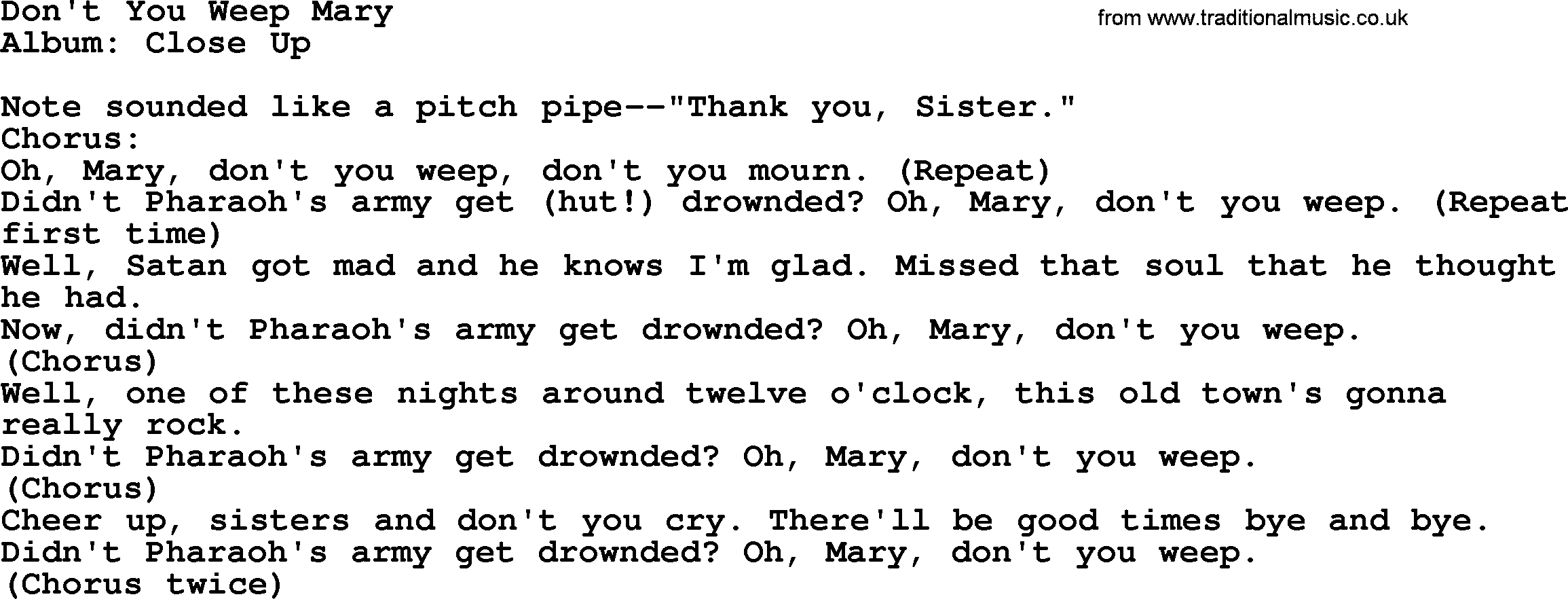
So, what is it actually? Basically, it’s a misnomer. Or a working title. Or a bit of lyrical DNA that ended up somewhere else entirely. If you’ve ever spent an afternoon lost in the "Get Back" sessions of the Beatles, you know how these things go. Bands jam. They mumble words. They steal from old folk songs. Rolling Stone Don't You Weep is essentially a variation of the traditional spiritual "Mary Don't You Weep."
It's a song with roots that go back way before rock and roll. Before electric guitars. Before the blues. We are talking about a pre-Civil War spiritual.
The confusion usually stems from various bootleg recordings, most notably the legendary Bright Lights, Big City sessions or the loose rehearsals around the Beggars Banquet era. If you listen to the outtakes from March 1968 at Olympic Studios in London, you can hear the band messing around with these motifs. Keith Richards is often the one steering these shipwrecks. He’s obsessed with the source material. He’s looking for that "it" factor that connects a modern riff to a hundred-year-old soul.
Why the Confusion Persists
Music history is messy. It’s not a neat line of A to B. It’s a tangle.
Collectors often mislabel tracks. Back in the day, when people were trading physical tapes, someone would hear Mick Jagger shout a line and suddenly that became the title of a "lost" masterpiece. Rolling Stone Don't You Weep is one of those titles that took on a life of its own in the gray market. It sounds so much like a "Stones" song that people just accepted it as a fact.
But here’s the kicker: The song most people are actually hearing when they think they’re listening to "Rolling Stone Don't You Weep" is often an early, skeletal version of something else. Or it's just a long, rambling blues jam that never got a proper bridge or a chorus.
The band was famously prolific during this window. Between 1968 and 1972, they were basically a factory of genius. But for every "Gimme Shelter," there were ten sketches that ended up on the cutting room floor. Some of those sketches had names. Some didn't. This one just happened to have a name that stuck in the craw of the fandom.
The Connection to "Sweet Virginia" and Beyond
If you listen to the acoustic, country-fried tracks on Exile on Main St., you can hear the echoes. The "don't you weep" sentiment is a trope. It's a foundational block of the music they were consuming.
Think about "Sweet Virginia." It’s got that same front-porch, beer-bottle-slide vibe. It’s easy to see how a fan in 1970, hearing a grainy bootleg of a rehearsal, might hear a line about weeping and a rolling stone and conclude they’d found a lost track.
The reality? It’s just the Stones being the Stones. They were sponges. They took the gospel of the American South and filtered it through their own messy, drug-fueled, London-based lens.
The Search for the Holy Grail
Is there a finished version? Short answer: No.
Longer answer: It depends on what you count as a "version." There are fragments. There are snippets of tape where Bill Wyman’s bass is too loud and Charlie Watts is just keeping a steady, hypnotic pulse while Mick mumbles about "rolling stones" and "weeping mothers."
It’s evocative stuff. It’s why people still care about Rolling Stone Don't You Weep decades after it was supposedly recorded. It represents a version of the band that felt more human. Less like a stadium-filling corporation and more like four or five guys in a dark room trying to figure out how to be Jimmy Reed.
What Experts Say
Musicologists like Richie Unterberger, who has spent way too much time documenting every breath the 1960s British Invasion bands took, often point to these sessions as the "missing link."
They show the work.
You see the seams.
You hear the mistakes.
That’s the beauty of the Rolling Stone Don't You Weep myth. It’s a reminder that even the greatest rock band in the world had to start with a dumb idea or a stolen lyric. They weren't always the "Greatest Rock and Roll Band in the World." Sometimes they were just a bunch of guys who couldn't remember the words to an old spiritual.
How to Actually Find It
If you’re dead set on hearing what all the fuss is about, you have to go off the beaten path. You won't find it on Spotify. At least not under that name.
Look for the Beggars Banquet outtakes. Specifically, look for the sessions from May and June of 1968. There’s a lot of acoustic guitar work there. You’ll hear things that sound like "No Expectations" but weirder. You’ll hear things that sound like "Dear Doctor" but slower.
And somewhere in that digital or magnetic soup, you’ll hear the phrase. Rolling Stone Don't You Weep. It’ll pass by in a second. If you blink, you’ll miss it. But for the hardcore collector, that one second is everything.
Why It Still Matters in 2026
In an era of perfectly polished, AI-assisted pop, there is something deeply refreshing about a "lost" song that is basically just a mess. It’s authentic. It’s dirty. It smells like stale cigarettes and old tube amps.
We live in a world where everything is indexed and tagged. Everything is "content." But Rolling Stone Don't You Weep resists that. It’s hard to pin down. It’s a reminder that the best parts of art are often the parts that weren't meant to be seen.
The accidental genius.
The throwaway line.
The song that never was.
Moving Forward with the Music
If you want to understand the DNA of this era, don't just stop at the bootlegs. To get the full picture of why a song like Rolling Stone Don't You Weep holds such power over the imagination, you need to go back to the sources.
- Listen to the Swan Silvertones. Their version of "Mary Don't You Weep" is arguably the definitive one. It’s got the grit that the Stones were trying to emulate.
- Dig into the Olympic Studios history. That room had a sound. It’s the sound of 1968. It’s the reason those bootlegs feel so heavy and atmospheric.
- Check the labels. If you see a bootleg with this title, look at the tracklist. Usually, it's a mislabeled version of "And I Was A Country Boy" or a generic "Blues Jam."
Stop looking for a finished masterpiece. It isn't there. Instead, appreciate the fragment for what it is: a window into the creative process of a band at the absolute peak of their powers.
The value isn't in the "song." The value is in the hunt.
For the true fan, the mystery of Rolling Stone Don't You Weep is far more interesting than a polished three-minute radio hit could ever be. It's a piece of the puzzle that never quite fits, and in the world of the Rolling Stones, those are always the best pieces.
Go find the bootlegs. Listen to the hiss of the tape. Feel the room. That’s where the real music is hiding.
Actionable Insight:
To truly understand the "Don't You Weep" mythology, start by cross-referencing the Beggars Banquet recording logs found on sites like "The Complete Works of the Rolling Stones" (Database). Look specifically for the "London, Olympic Sound Studios" entries from early 1968. Compare these raw acoustic takes to the finalized versions on the album; you'll see how a traditional spiritual motif was dismantled and rebuilt into the blues-rock foundation that defined the band's second golden era. Don't waste money on overpriced "unreleased" vinyl that claims to have a studio-quality version—it's almost certainly a fake or a common outtake under a different name. Stick to the digital archives where community verification helps weed out the mislabeled tracks.